





Transport plays a central role in South Africa’s greenhouse gas (GHG) emissions, contributing approximately 14% of national energy-related CO₂ emissions. With road transport responsible for 90% of that, the way we travel, particularly to and from work, has a considerable impact on the environment.
In 2024, approximately 17.1 million South Africans commuted to work, with the majority depending on motorised transport. This resulted in an estimated 11,260 kilotonnes of CO₂ equivalent (ktCO₂e) in emissions solely from commuting. These figures, excluding business travel, underscore the environmental impact of daily mobility.
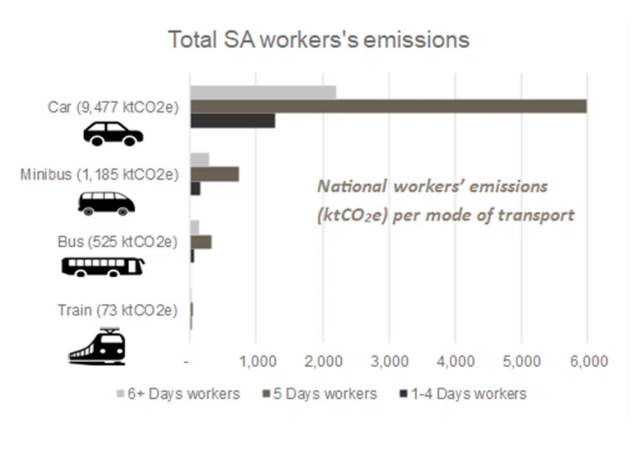
Motorcars are the largest contributors to commuting emissions, followed by minibus taxis. Trains, while less widely used, had the lowest carbon impact. Workers commuting five days a week consistently generated the highest emissions across all transport modes. In contrast, individuals commuting fewer than four days a week, likely part-time or hybrid workers, produced significantly lower emissions.
Gauteng, Western Cape, and KwaZulu-Natal lead the country in provincial emissions, while Northern Cape and the Free State contribute the least. These regional differences reflect both population density and available transport infrastructure.
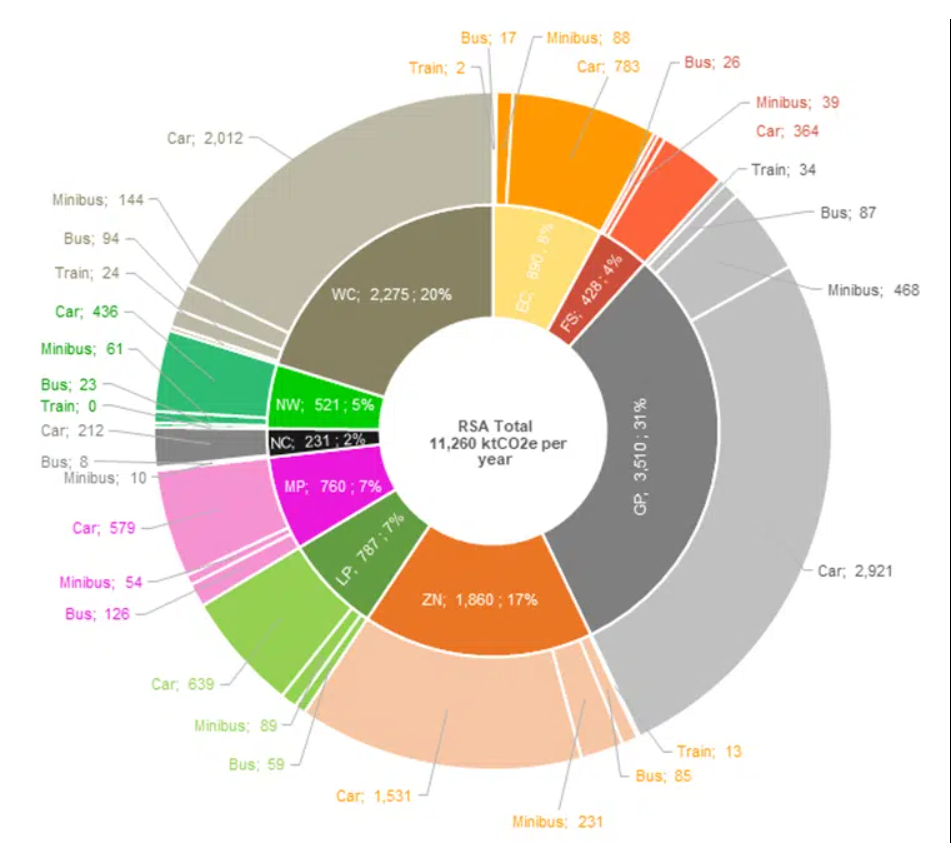
Provinces; EC = Eastern Cape, FS = Free State, GP =Gauteng, ZN = KwaZulu-Natal, LP = Limpopo, MP = Mpumalanga, NC = Northern Cape, NW = Northwest, WC = Western Cape
As a signatory to the Paris Agreement, South Africa has committed to measurable climate action. Tracking emissions from commuting is a key part of developing practical, bottom-up climate strategies.
This Workers’ Day 2025, we recognise the connection between daily commuting choices and our collective environmental responsibility. Through smarter transport planning, sustainable infrastructure, and a
transition towards low-emission mobility, we can all contribute to creating a cleaner, more connected future.
Zutari, a leader in impact engineering, supports this goal by providing carbon footprint assessments for governments, companies, and communities across Africa and the Middle East.

